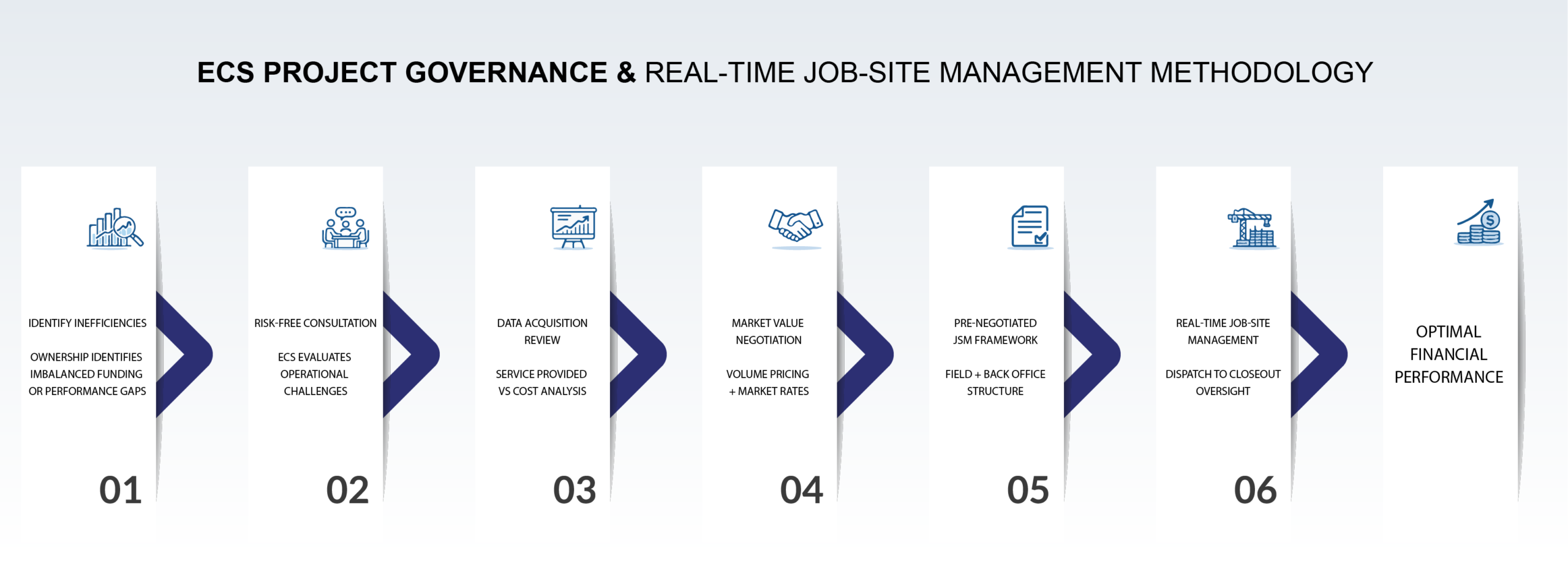
1. Ownership Identifies Inefficiencies
The ECS process begins when ownership identifies inefficiencies, operational challenges, or imbalanced funding between services received and cost. These concerns often arise when projects experience cost escalation, inconsistent performance, or lack of visibility into job-site execution.
Organizations typically recognize these issues but may not have the resources to monitor and manage real-time operational details. ECS provides independent oversight to help address these challenges and improve overall performance.
This initial step allows ECS to understand the client’s operational environment, performance expectations, and financial objectives.
2. Risk-Free Consultation with ECS
ECS conducts a risk-free consultation with key stakeholders to evaluate operational challenges and identify opportunities for improvement. During this phase, ECS gathers preliminary information and reviews project conditions.
The consultation focuses on:
- Operational challenges
- Cost concerns
- Contractor performance
- Coordination issues
- Service delivery expectations
This collaborative discussion helps define objectives and establish a framework for improvement.
3. Data Acquisition and Performance Review
Following the consultation, ECS performs a data acquisition review of recent service events. This evaluation focuses on analyzing service provided versus cost to determine value for dollars spent.
ECS reviews:
- Recent service activities
- Contractor performance
- Cost structures
- Operational workflows
- Execution efficiency
This data-driven approach provides objective insight into operational performance and identifies areas for improvement.
By analyzing historical performance, ECS establishes a baseline for improved execution and financial alignment.
4. Market Value Assessment and Negotiation
Once performance data is reviewed, ECS works with trusted, vetted partners to identify current market-value pricing. ECS then negotiates volume-based pricing and establishes cost structures for future services.
This phase helps clients achieve:
- Competitive market pricing
- Cost predictability
- Improved budgeting
- Reduced financial risk
Pre-negotiated pricing frameworks allow ECS to manage services efficiently while maintaining cost control.
5. Pre-Negotiated Job-Site Management Framework
ECS develops field and back-office documentation to support real-time Job-Site Management. This framework establishes procedures, expectations, and communication channels for efficient execution.
This includes:
- Dispatch procedures
- Scope definitions
- Performance expectations
- Communication protocols
- Documentation standards
By creating this structured environment, ECS ensures consistent execution and improved coordination.
6. Real-Time Job-Site Management and Execution
ECS and trusted partners perform services within both pre-planned and emergency dispatch environments. ECS manages each service event from dispatch through closeout, ensuring efficient execution and optimal value.
ECS manages:
- Dispatch coordination
- Field execution oversight
- Contractor coordination
- Performance monitoring
- Closeout procedures
- Final payment alignment
This real-time oversight ensures services delivered remain aligned with cost expectations and operational objectives.