ECS Methodology

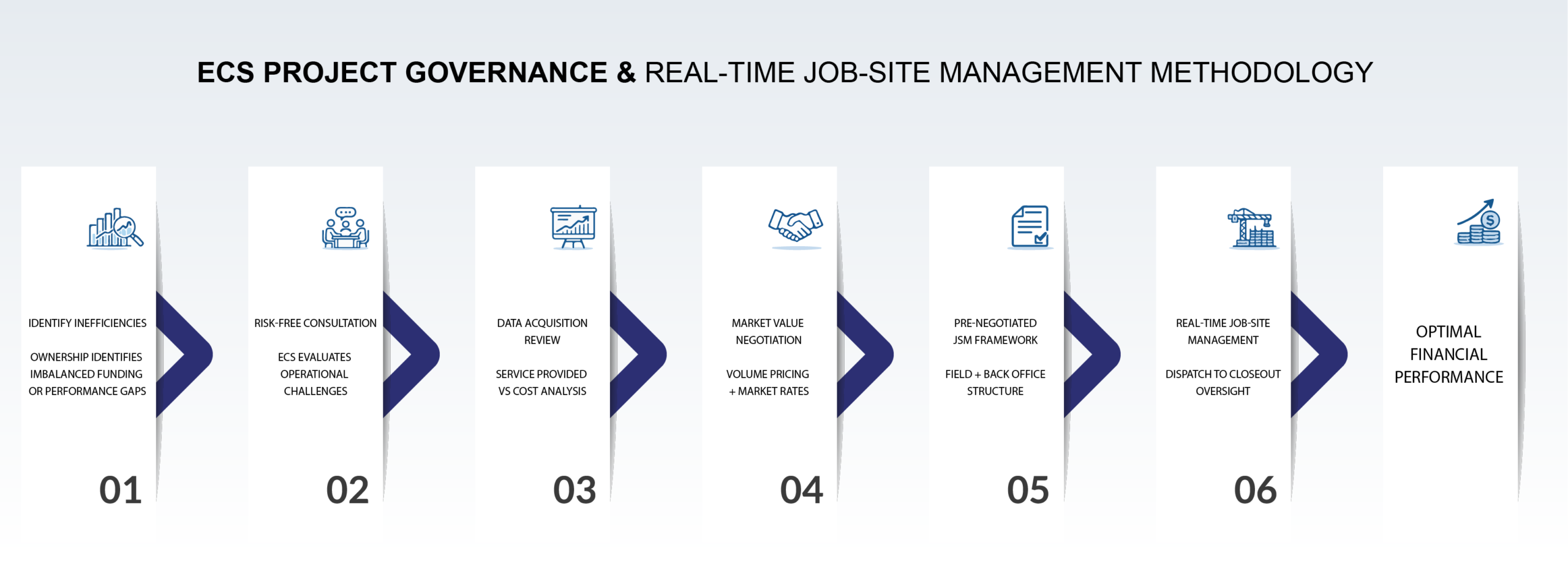
ECS methodology is structured, designed to improve operational efficiency, control costs, and optimize financial performance. Our approach is centered on Real-Time Job-Site Management (JSM), providing independent oversight for organizations that possess strong technical expertise but require support managing execution details, coordination, and real-time events that influence outcomes.

This methodology allows ECS to identify inefficiencies, implement practical solutions, and manage service events from initial assessment through final payment. By focusing on execution details and financial alignment, ECS helps organizations ensure services delivered match value received.

ECS Methodology

ECS Methodology

1. Ownership Identifies Inefficiencies

The ECS process begins when ownership identifies inefficiencies, operational challenges, or imbalanced funding between services received and cost. These concerns often arise when projects experience cost escalation, inconsistent performance, or lack of visibility into job-site execution.

Organizations typically recognize these issues but may not have the resources to monitor and manage real-time operational details. ECS provides independent oversight to help address these challenges and improve overall performance.

This initial step allows ECS to understand the client’s operational environment, performance expectations, and financial objectives.

2. Risk-Free Consultation with ECS

ECS conducts a risk-free consultation with key stakeholders to evaluate operational challenges and identify opportunities for improvement. During this phase, ECS gathers preliminary information and reviews project conditions.

The consultation focuses on:

  • Operational challenges
  • Cost concerns
  • Contractor performance
  • Coordination issues
  • Service delivery expectations

This collaborative discussion helps define objectives and establish a framework for improvement.

3. Data Acquisition and Performance Review

Following the consultation, ECS performs a data acquisition review of recent service events. This evaluation focuses on analyzing service provided versus cost to determine value for dollars spent.

ECS reviews:

  • Recent service activities
  • Contractor performance
  • Cost structures
  • Operational workflows
  • Execution efficiency

This data-driven approach provides objective insight into operational performance and identifies areas for improvement.

By analyzing historical performance, ECS establishes a baseline for improved execution and financial alignment.

4. Market Value Assessment and Negotiation

Once performance data is reviewed, ECS works with trusted, vetted partners to identify current market-value pricing. ECS then negotiates volume-based pricing and establishes cost structures for future services.

This phase helps clients achieve:

  • Competitive market pricing
  • Cost predictability
  • Improved budgeting
  • Reduced financial risk

Pre-negotiated pricing frameworks allow ECS to manage services efficiently while maintaining cost control.

5. Pre-Negotiated Job-Site Management Framework

ECS develops field and back-office documentation to support real-time Job-Site Management. This framework establishes procedures, expectations, and communication channels for efficient execution.

This includes:

  • Dispatch procedures
  • Scope definitions
  • Performance expectations
  • Communication protocols
  • Documentation standards

By creating this structured environment, ECS ensures consistent execution and improved coordination.

6. Real-Time Job-Site Management and Execution

ECS and trusted partners perform services within both pre-planned and emergency dispatch environments. ECS manages each service event from dispatch through closeout, ensuring efficient execution and optimal value.

ECS manages:

  • Dispatch coordination
  • Field execution oversight
  • Contractor coordination
  • Performance monitoring
  • Closeout procedures
  • Final payment alignment

This real-time oversight ensures services delivered remain aligned with cost expectations and operational objectives.

Continuous Improvement Through Real-Time Oversight

ECS Methodology

ECS methodology is designed to support continuous improvement. Performance data is collected and evaluated to refine execution strategies and improve future service events.

This ongoing process allows ECS to:

  • Improve operational efficiency
  • Strengthen contractor performance
  • Reduce risk
  • Improve financial outcomes

By combining structured methodology with real-time Job-Site Management, ECS provides organizations with practical oversight that improves performance and optimizes value.

How ECS Implements Its Execution Tools

ECS implements its execution tools through a structured, real-time approach designed to improve operational efficiency, strengthen oversight, and optimize financial outcomes. These tools are not standalone features—they are integrated into ECS’s Real-Time Job-Site Management (JSM) methodology to support every stage of project execution, from initial evaluation to final closeout.

A Structured, Real-Time Implementation Approach

ECS begins by evaluating each client’s operational environment, identifying inefficiencies, cost imbalances, and coordination gaps. Once opportunities for improvement are identified, ECS introduces its execution tools in a structured manner that aligns with both field operations and back-office requirements. This ensures that implementation is seamless and supports existing workflows rather than disrupting them.

Each execution tool is designed to work together as part of a unified system, allowing ECS to monitor performance, respond to real-time events, and manage project activities efficiently.

Pre-Negotiated Fixed Rates

ECS implements pre-negotiated fixed rates by working with trusted and vetted partners to establish market-aligned pricing before services are required. This proactive approach eliminates uncertainty during project execution and helps ownership maintain control over costs.

Through volume-based negotiations and market benchmarking, ECS develops pricing structures that support both planned work and emergency dispatch scenarios. These agreements are documented and integrated into ECS’s operational framework, allowing teams to move forward quickly without delays caused by pricing negotiations.

This approach improves transparency, reduces administrative effort, and ensures services are delivered at competitive market value.

Real-Time Dispatch with Rapid Response

ECS implements real-time dispatch capabilities to ensure operational continuity and responsiveness. When service needs arise—whether planned or unexpected—ECS coordinates dispatch activities using its established partner network and communication protocols.

The goal is to provide rapid response while maintaining oversight and accountability. ECS manages dispatch coordination, monitors service progress, and ensures work aligns with pre-negotiated terms and performance expectations.

This structured dispatch approach supports both routine operations and emergency environments, allowing organizations to maintain performance while minimizing operational disruption.

Job-Site Management Software

ECS integrates job-site management software to support real-time oversight and coordination. This technology enables ECS to track service events, monitor performance, and maintain visibility across all project activities.

The software platform supports communication between field personnel, contractors, and stakeholders, ensuring information flows efficiently. ECS uses this data to manage sequencing, monitor productivity, and identify potential issues early.

By leveraging digital tools, ECS enhances transparency and provides ownership with real-time insight into job-site performance and operational progress.

Performance Data Acquisition and Analytics

ECS captures performance data throughout the execution process. This data-driven approach allows ECS to evaluate service delivery, identify trends, and support continuous improvement.

Performance analytics help ECS measure service-to-cost alignment, contractor performance, and operational efficiency. These insights allow ECS to refine processes, improve decision-making, and strengthen long-term outcomes.

By combining data acquisition with real-time job-site management, ECS helps organizations make informed decisions that support optimal financial performance.

Integrated Execution for Optimal Value

ECS execution tools are most effective when used together. Pre-negotiated rates reduce cost uncertainty, real-time dispatch ensures responsiveness, job-site management software provides oversight, and performance analytics support continuous improvement.

This integrated system allows ECS to manage projects from dispatch to closeout, ensuring operational alignment and financial efficiency at every stage. By implementing these tools within its Real-Time Job-Site Management framework, ECS helps clients achieve better performance, improved accountability, and stronger financial outcomes.

Through structured implementation and real-time oversight, ECS transforms operational challenges into measurable value.

A Methodology Focused on Results

ECS methodology is designed to support organizations that already possess strong technical expertise but require independent oversight of execution details. By managing real-time job-site events and operational coordination, ECS helps clients achieve improved financial performance and consistent execution.

Through structured processes, data-driven decisions, and real-time oversight, ECS delivers Job-Site Management that improves outcomes and maximizes value.

Evaluate Your Project Environment

If your organization is managing a complex capital construction program, we can assess execution conditions and identify structural risks before they escalate.
Submit Project Overview