
Execution Governance System
Large capital construction programs operate within environments defined by contractual structures, coordination dependencies, and procedural systems intended to guide execution.
At project initiation, these systems are typically well established. Contracts define obligations. Procedures outline execution protocols. Coordination frameworks establish how contractors, engineering teams, and project stakeholders interact.
As project environments expand, however, execution discipline often begins to degrade.
Contractual requirements may be interpreted differently across teams.
Coordination between contractors becomes less structured.
Operational procedures are applied inconsistently across divisions and project phases.
These conditions do not result from lack of effort.
They result from the absence of a structured governance system that maintains alignment across all layers of execution.
Our methodology is designed to address this condition directly.
We identify structural breakdowns in contractual enforcement, coordination discipline, and procedural compliance — then implement engineered governance systems that restore accountability, maintain consistency, and stabilize execution across complex capital construction environments.
This methodology is not advisory in nature.
It is a system-based approach focused on establishing measurable control frameworks that ensure execution remains disciplined, enforceable, and aligned with the interests of ownership stakeholders throughout the lifecycle of the project.
Governance System Architecture
Our methodology is implemented as a structured governance system designed to maintain execution discipline across complex construction environments.
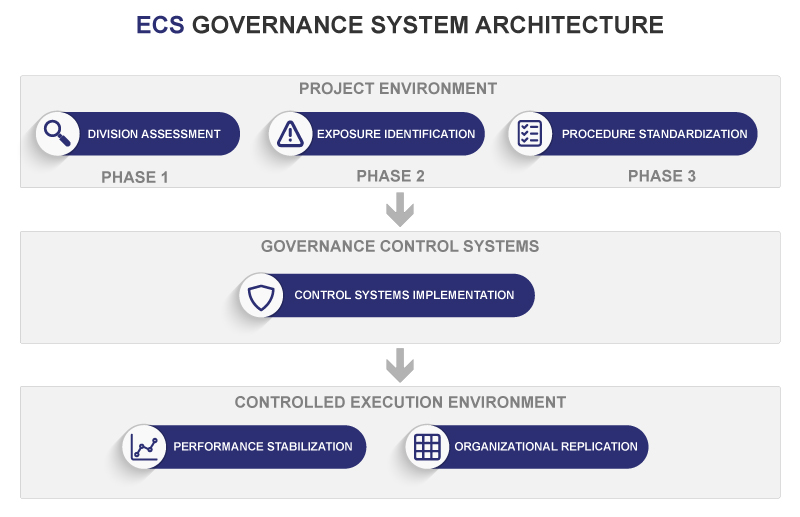
Phase 1 — Division Assessment
We begin by evaluating a defined division or project environment to understand how contractual obligations, coordination structures, and operational procedures are applied in practice.
This assessment focuses on actual execution conditions rather than documented processes, providing a clear view of how governance is functioning within the project environment.
Phase 2 — Exposure Identification
Following assessment, we identify structural exposure points where execution becomes vulnerable.
These exposure points typically emerge where contractual enforcement is inconsistent, coordination between contractors is fragmented, or procedural compliance has weakened.
This phase isolates the specific conditions that create instability within the project environment.
Phase 3 — Procedure Standardization
Once exposure points are identified, we establish enforceable procedures that align contractual interpretation, coordination protocols, and operational practices across the division.
This phase introduces structured governance standards designed to eliminate variation and ensure consistent execution across all project participants.
Control Systems Implementation
At the center of the methodology is the implementation of measurable governance control systems.
These systems actively maintain execution discipline across the project environment by enforcing contractual accountability, structuring coordination between contractors, and ensuring procedural compliance.
Control systems include:
• contractual compliance monitoring
• coordination governance frameworks
• risk identification and escalation protocols
• performance measurement systems
These systems transform governance from a reactive function into a continuous, structured oversight mechanism.
Performance Stabilization
As governance systems are implemented, execution conditions begin to stabilize.
Contractual obligations are consistently enforced.
Coordination between contractors becomes structured and predictable.
Operational procedures are applied with discipline across the project environment.
This stabilization creates a controlled execution environment where risks are identified early and managed proactively.
Organizational Replication
Once governance systems have stabilized execution within the initial division, the framework can be replicated across additional divisions or project environments.
This phased implementation approach allows organizations to establish consistent governance systems across the broader capital program while minimizing disruption to ongoing operations.
Over time, this creates a unified governance architecture that maintains execution discipline across the entire organization.
Governance Systems Implementation Results
The implementation of structured governance systems results in a project environment where:
• contractual obligations are consistently enforceable
• coordination between contractors remains structured and disciplined
• procedural compliance is measurable and accountable
• execution risks are identified early and managed proactively
This governance architecture provides ownership stakeholders with the operational stability required to protect complex capital construction programs.
Complex construction environments do not fail due to lack of capability.
They fail when execution systems lose alignment.
Our methodology restores that alignment by establishing governance systems that enforce accountability, maintain coordination discipline, and ensure consistent execution across the project environment.
Evaluate Your Project Environment
If your organization is managing a complex capital construction program, we can assess execution conditions and identify structural risks before they escalate.